
CSCA syllabus and study resources
Understand all five offered CSCA subjects, 2025-edition syllabi, official sample links and independent study methods, with programme-specific selection checks.
Offered subjects, not a compulsory combination. The issuer currently links 2025-edition syllabi; your university and programme determine required subjects.
The CSCA preparation page links eight syllabus documents, all labelled as the 2025 edition. Syllabus editions are separate from admission years. Use the official CSCA preparation page for the syllabus linked to your sitting.
Use this page as a topic roadmap and a study organiser. The linked issuer documents remain the authoritative syllabus. Our preparation suggestions below are independent FirstLiners study methods; they are not an official course, examination prediction, score forecast or guarantee.
Start with the subjects your application actually requires
The current offered set is Mathematics, Physics, Chemistry, Humanities Chinese and STEM Chinese. The last two sit under the issuer's Professional Chinese category. “STEM Chinese” is the current English website label for 理科中文; “Science Chinese” is sometimes an explanatory translation, not a sixth subject. The preparation page does not currently offer separate Business Chinese or Medical Chinese syllabus downloads. Translation strings alone do not establish an available examination. Official preparation page
An offered subject is not automatically a requirement for your application. CSCA's current FAQ directs students to their intended universities and programmes for subject requirements. For each course, confirm the exact subject combination, Chinese-track category where relevant, test language, acceptable sitting/report date, score requirement and submission deadline. Keep the university's dated source or written answer with your plan. A university's rule for one programme or intake must not become a rule for every MBBS applicant, every scholarship or every future intake. Official FAQ, version 12, questions 6–8
| Record before registering | Your entry |
|---|---|
| University, exact degree and intake | Leave unresolved until confirmed |
| Funding route and teaching language | Confirm the route you will actually apply through |
| Required CSCA subjects and Chinese category | Copy the institution's exact requirement into your private plan |
| Test language for each fundamental subject | Use the target institution's requirement |
| Accepted report date, score and deadline | Save the programme requirement and its date |
| Conflicting or missing instructions | Ask the institution before paying for a subject combination |
Do not assume that an English-taught programme automatically gives a particular exemption, that an HSK result substitutes for Professional Chinese, or that one national pass mark guarantees admission. These sources do not establish those claims.
Published format at a glance
- Mathematics: sets and inequalities; functions; geometry and algebra; probability and statistics.
- Physics: mechanics; electricity and magnetism; thermodynamics; optics and modern physics.
- Chemistry: foundations and calculations; substances, reactions and principles; laboratory work and applications.
- Professional Chinese — STEM Chinese: academic language for scientific concepts, formulas, experiments, charts and reading.
- Professional Chinese — Humanities Chinese: academic language for humanities, including characters, vocabulary, completion tasks and reading.
This is an offered-subject overview based on the 2025-edition syllabi. It is not a mandatory bundle for every applicant or a complete syllabus. Confirm the exact university, programme, intake, required papers and test language, then open the full official syllabus.
| Offered subject | Test language | Duration | Questions | Score scale |
|---|---|---|---|---|
| Mathematics | Chinese or English | 60 minutes | 48 single-answer multiple-choice questions | 0–100 |
| Physics | Chinese or English | 60 minutes | 48 single-answer multiple-choice questions | 0–100 |
| Chemistry | Chinese or English | 60 minutes | 48 single-answer multiple-choice questions | 0–100 |
| Professional Chinese: Humanities Chinese | Chinese | 90 minutes | 80 multiple-choice questions | 0–100 |
| Professional Chinese: STEM Chinese | Chinese | 90 minutes | 80 multiple-choice questions | 0–100 |
The fundamental-subject PDFs specify their question counts and single-answer format. The two Chinese PDFs specify 90 minutes, 100 points and single-answer tasks; the 80-question count is stated in the current official CSCA introduction, rather than in those Chinese PDFs. The current FAQ confirms language choices per subject, with the institution's language requirement controlling the choice. The linked syllabus documents do not give topic-by-topic marks or weighting.
Mathematics: connect notation, graphs and reasoning

What the published topic map covers
The syllabus moves from working with sets and solving inequalities to functions, geometry and data. Its functions strand includes permitted inputs and outputs, increasing/decreasing behaviour and symmetry; power, exponential, logarithmic and trigonometric forms; arithmetic/geometric sequences; and introductory derivatives/calculus. Geometry includes coordinate work with straight lines, circles and conic sections, vectors, complex arithmetic and simple three-dimensional solids. The data strand includes elementary probability, averages and spread, and the idea of a normal distribution. Official Mathematics syllabus, 2025, pages 1–2
How to turn that into preparation
These are FirstLiners study methods, not additional official syllabus requirements:
- Translate before calculating. For a function problem, write what the input is allowed to be; sketch its shape; then calculate. For a rational expression, mark excluded values before manipulating it.
- Use several representations. Keep a formula, a graph and a one-sentence explanation together. For a sequence, compare the written rule with its first few terms and the sum you expect.
- Draw the geometry. Mark axes, points and quantities before selecting an equation. For vectors and complex numbers, practise explaining what a calculation means as well as completing it.
- Check the statistical interpretation. Distinguish a probability from a count, and an average from a measure of spread. Explain a normal curve in words before using a formula.
- Record error types. Separate an algebra slip, a missing domain restriction, a graph-reading error and a misunderstood question. Repair the cause with a fresh example rather than only memorising the corrected answer.
Method example: take a routine rational-inequality exercise from a textbook you are allowed to use. Make a number-line sign chart, circle forbidden denominator values, solve, then test one value from each interval. This is a study routine, not an official CSCA question or an answer prediction.
Physics: choose a model before choosing a formula
What the published topic map covers
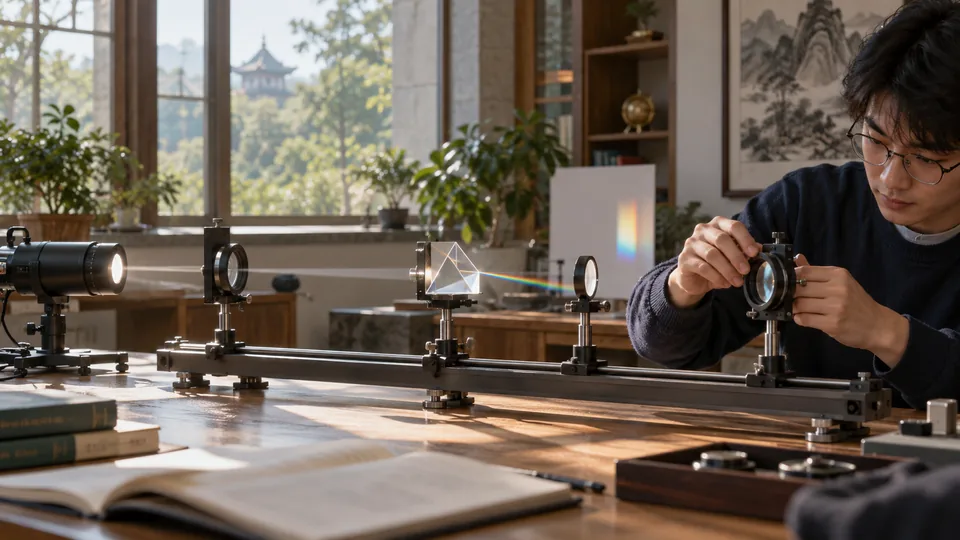
Mechanics covers motion and acceleration, Newtonian forces, impulse/momentum, work/energy, circular/gravitational motion, oscillation and waves. Electrical and magnetic work includes charge, fields and potential; direct-current networks; magnetic forces; and induction. Thermal topics cover gas-particle ideas, the ideal-gas relationship and energy transfer under the first law. Optics includes reflection/refraction and wave effects. The modern-physics strand introduces the photoelectric effect, atomic structure and nuclear basics. Official Physics syllabus, 2025, pages 1–2
How to turn that into preparation
These are independent study methods:
- Name the system. State which object or collection of objects you are analysing. Decide which forces, energy transfers or interactions belong in that system.
- Draw first. Use a force diagram, a circuit, a ray sketch or a wave sketch as appropriate. Label directions and known quantities. A correct picture often reveals a mistaken assumption early.
- Keep assumptions beside formulas. Ask when a relationship applies and what would make it fail. Write units on every quantity and check the final dimensions.
- Compare related concepts. Explain the difference between velocity and acceleration, field and potential, or current and voltage without relying only on symbols.
- Practise interpretation as well as arithmetic. Describe what a graph slope, area or change means in the physical situation. Check whether the size and direction of a result are plausible.
Method example: use an ordinary textbook motion problem. Draw the motion, choose a positive direction and list the known quantities. After solving, check units and ask how the result should change if the starting speed increases. This builds model selection; it does not predict an exam item.
Chemistry: connect quantities, particles and observations

What the published topic map covers
The foundations include matter and changes of state, chemical notation, equations, amount-of-substance calculations, concentration, pH and gas relationships. Substance work covers common inorganic families, introductory organic compounds, oxidation/reduction and ionic identification. Theory includes atomic/periodic patterns, bonding and molecular interactions, reaction speed, equilibrium and electrolytes. Experimental/application topics include safe apparatus use, common gas preparation and recognition, separation/purification and industrial-process reasoning. Official Chemistry syllabus, 2025, pages 1–2
How to turn that into preparation
These are independent study methods:
- Set out the calculation path. Identify the given quantity and the quantity requested. Balance the equation when relevant, convert units, then show each conversion rather than skipping straight to a number.
- Explain observations with particle ideas. Relate an observed change to the substances and interactions involved. Keep the observation separate from your interpretation of it.
- Build comparison cards. For related substances or reaction types, record the key difference and the evidence that would distinguish them. Avoid learning isolated colour changes without the conditions in which they occur.
- Reason through an experiment on paper. Identify the purpose of each apparatus item, the variable being changed, the observation being made and the limitation of the conclusion.
- Review safely. Use diagrams, approved classroom activities and supervised laboratory teaching. A preparation guide is not an instruction to improvise hazardous experiments at home.
Method example: use a permitted classroom stoichiometry exercise. Draw a conversion chain from the supplied measurement to amount of substance, apply the balanced-equation ratio and convert to the requested quantity. Check units and whether the magnitude makes sense. This is a learning routine, not a sample CSCA question.
Professional Chinese: academic reading in two contexts

These examinations assess Chinese used for university study. They are not presented here as a replacement for a university's separate language-admission requirements. The following section explains the distinction between the two published tracks; the institution must tell you which category, if any, your application requires.
Humanities Chinese — 文科中文
The syllabus targets language needed in first-year humanities study: following subject teaching, extracting and noting important information, identifying an academic text's central meaning and reading with appropriate reference support. Its contexts span literature and languages, philosophy, law/politics, education and society, history, and the arts/media/design. The tasks combine character recognition, vocabulary use and distinction, completing connected text or sentences, and reading comprehension. Official Humanities Chinese syllabus, 2025, pages 1–2
Independent study method: read a short, lawfully available humanities passage at a suitable level. Write its main claim, find the sentence supporting it, then mark a connector showing cause, contrast or sequence. Create vocabulary cards with the word in context and a similar word it could be confused with. Practise deciding which word fits the author's meaning and register. Do not turn a list of humanities disciplines into a claim that specialist knowledge of every discipline is separately tested.
STEM Chinese — 理科中文
The syllabus targets academic Chinese for first-year science/engineering study. Contexts include mathematical notation and formula language, physical laws, chemical equations, laboratory terminology, introductory computing/programming language and academic tasks such as explaining a process or interpreting data. It expects students to engage with disciplinary textbooks and use references for harder academic material. It uses the same broad character, word-choice, completion and reading task families as Humanities Chinese. Official STEM Chinese syllabus, 2025, pages 1–2
Independent study method: choose a familiar scientific explanation written in Chinese. Identify its definitions, quantities, comparison words and conclusion. Match a sentence to a simple diagram or table you create yourself. Read a familiar formula aloud in Chinese and explain the relationship without calculating. A language difficulty and a science-concept difficulty need different practice, so record them separately. The presence of computing terminology does not establish a separate programming practical examination.
A shared practice routine for the language tasks
The routine below is FirstLiners advice, not an official vocabulary list or question bank:
| Skill to practise | A useful study action |
|---|---|
| Character recognition | Compare easily confused forms inside real words, then retrieve them later without looking |
| Vocabulary in context | Record meaning, usual combinations and the tone/register of the sentence |
| Choosing between similar words | Explain the difference and write a new sentence where only one fits naturally |
| Connected-text completion | Track pronouns, reference words, connectors and the paragraph's direction |
| Sentence completion | Check grammar and the surrounding meaning together |
| Reading | Skim for the main idea, scan for the requested detail, then identify evidence in the passage |
Listening to a lecture and discussing a subject may be valuable preparation for university study, but the published task table lists single-answer tasks. Do not advertise an assessed speaking interview, essay or listening paper on the basis of the syllabus's broad learning goals.
Official downloads: choose the document language carefully
The issuer currently provides these syllabus files. Document language and examination language are separate choices. Downloading the English mathematics PDF does not choose the language of your registration.
| Subject | Issuer syllabus links | Edition and page count |
|---|---|---|
| Mathematics | English PDF · Chinese PDF | 2025; 2 pages each |
| Physics | English PDF · Chinese PDF | 2025; English 2 pages, Chinese 3 pages |
| Chemistry | English PDF · Chinese PDF | 2025; 2 pages each |
| Humanities Chinese | Chinese PDF | 2025; 2 pages |
| STEM Chinese | Chinese PDF | 2025; 2 pages |
The Chinese Physics PDF's extra page is a pagination difference; both versions describe matching topic areas. It does not establish a harder examination or a new edition.
The current preparation page also links Mathematics samples, Physics samples and Chemistry samples. Use the sample version provided for your sitting. Public Humanities/STEM Chinese sample availability is not confirmed. Official preparation page
Use official samples to understand presentation and practise your review process. A sample is not a prediction of a future paper, a complete explanation of marks, or a guaranteed difficulty benchmark. Academic sample practice is also distinct from any required technical/system mock for the selected test sitting; follow current official candidate instructions for that process.
Build a preparation cycle you can repeat
This is an adjustable FirstLiners workflow. It is not a promise that a particular number of weeks is sufficient.
- Confirm the application requirement. Resolve the subject/language table above before choosing paid subjects. Save the university source privately; do not publish applicant details in a public planner or screenshot.
- Open the official syllabus. Mark a topic as “unfamiliar”, “can explain”, “can solve with help” or “can handle independently”. Do this for every module in each required subject.
- Diagnose before rereading everything. Try a small selection of allowed exercises without notes. Record where your reasoning stops. For a Chinese-language subject, separate unfamiliar language from unfamiliar concepts.
- Repair one weakness at a time. Review the relevant lesson, explain it in your own words, complete a worked example and then try a new task without copying the steps.
- Mix topics. Once individual ideas make sense, alternate topics so that you must decide which method fits. Revisit earlier mistakes after a gap.
- Practise with time awareness. Work in the confirmed examination language. At the published total pace, 60 minutes for 48 questions averages 75 seconds each; 90 minutes for 80 averages 67.5 seconds. These are arithmetic planning averages, not official per-question limits or advice to spend the same time on every question.
- Review the reasoning. For each mistake, write what you misunderstood, how to recognise that situation again and one next action. Track independent completion and explanation quality; a practice percentage is not an official CSCA score or admission decision.
- Recheck before the sitting. Reopen issuer notices, your admission ticket and the target university's instructions. Keep registration, identity, equipment, room, test rules and technical-mock preparation alongside academic preparation. Consult the existing FirstLiners CSCA operational guide and the official CSCA website for those changing details.
What this guide does not establish
The syllabi do not supply topic weightings, a universal admission cut-off, a conversion from practice accuracy to official score, a full formula/vocabulary list, guaranteed future questions or an automatic subject exemption. A topic's inclusion does not tell us how many questions it will receive. The linked syllabus documents do not state an expiry date or a future edition date. The 2025 label does not establish an expiry.
FirstLiners can help organise requirements and a preparation plan. Examination registration and official instructions remain with CSCA; admission and scholarship decisions remain with the relevant institution or authority.
Use the subject roadmaps below to plan your preparation. Download the complete syllabi and sample materials from the CSCA resources linked below.